
Delta Range: A Mountaineering Playground
The Delta Range: A Mountaineering Playground by Stan Justice is an overview of many of the peaks, routes, and first ascents in the Deltas, an area of the Eastern Alaska Range that spans between the Richardson Highway and the Tok Cutoff. It includes the major access routes to the mountains, information about the three club huts, and maps of popular climbs.
Available at Beaver Sports and REI
Fairbanks Area Rock Climbing Guide
The Fairbanks Area Rock Climbing Guide by Frank Olive and Stan Justice covers the rock climbing areas in Interior Alaska, including Grapefruit Rocks, Angel Rocks, Granite Tors, Mountain Prindle, and several bouldering crags. The Mt. Prindle Area Climbing Guide has been updated and included in this book. There are numerous updates to all areas. The most active area of development has been at Grapefruit Rocks, with over 30 new routes and many bolts added since the 2009 edition.
Available at Beaver Sports, REI, and Outdoor Adventures
Climbing Near Fairbanks
Grapefruit Rocks
To get to Grapefruit rocks, go north on the Steese Expressway. When you get to Fox, go straight, and the road turns into the Elliot Highway. It is also the road to Prudhoe Bay, so expect to share the road with 18-wheelers. At mile 28, the road crests a shoulder of Wickersham Dome, and then the pavement ends. Another 8 miles and you cross Globe Creek. The grey rocks straight in front of you and up the hill are Upper Grapefruit. The rocks left of the road and out on a shoulder are Lower Grapefruit.
Upper Grapefruit Rocks
As you drive across Globe Creek at mile 38 on the Elliot Highway, Upper Grapefruit is visible on the hill in front of you. Continue past a big road cut on your right and watch for a small ratty dirt road that hooks back to a sloping parking area just past the big cut. There are a number of trails leading up to the rocks, but please use the two main trails to minimize erosion. There is a South (S) trail and a North (N) trail.
Lower Grapefruit Rocks
Continue up Elliot Highway past the Upper Grapefruit parking for half a mile, watching for a pullout on the left, before the guard rail starts. Park at the pullout. Walk up a muddy jeep road a quarter mile until it ends at a trashy party spot. Through the trees, you can see the first rock.
Angel Creek Rocks
Angel Creek Rocks are a collection of granite outcrops located at Mile 49 of Chena Hot Springs Road. Watch for a sign near a bridge over the Chena pointing to the trail head.
The maintained trail is shaped like a tennis racket, the handle getting you in the vicinity of the rocks, and the head making a loop around to all the picnic spots. Climbers rarely use the trail, preferring to cut cross-country to their destination, which results in what is known as "climbers’ trails" or "social trails" (also known as erosion). Please stay on the main trail as much as possible.
The rock at Angel Creek is solid in places and rough in other places; the crystals are not well cemented, making for a surface that tends to slough off and the occasional loose block. The rocks also tend to be covered with lichen and moss, especially on the north sides. A considerable amount of gardening has removed most of the debris from the routes described here.
The routes are primarily top-rope climbs, but a few of them offer natural protection for leading.
Granite Tors
To get to the area, go out the Chena Hot Springs Road to 39 Mile and park at the campground on the left side of the road. There is now a maintained loop trail that accesses the area. From the parking area, cross the road and the bridge and find the trail up the south bank of the Chena River. As the trail leaves the river, there is a fork with the right trail leading to the most developed rocks (2 hours). The left trail will take you to the North Tor and the East Tor Island Group (2½ to 3 hours).
Rock 1 and Lizard’s Eye can be done as a day climb, but a visit to the more distant tors is usually an overnight outing. Water can be a problem after June, if the weather has been hot and dry. Search the base of large boulders where, for some reason, there are deep depressions that hold water. There are also some springs shown on the overview map on page 32. All water should be filtered or boiled before use.
Getting lost can also be a problem at the tors, especially in early spring when parts of the trail are snow-covered. Foggy weather can obscure landmarks, making it easy to follow one of the many game trails down into Marten Creek drainage, a serious mistake. Take a compass and keep track of the Rock Creek drainage, which the trail circles. Roman Dial recommends whistling and listening for echoes.
The right-hand trail goes up three hills, with the second being barely noticeable and the third being the steepest and longest. If you look closely, you will notice stumps lying all in one direction where tracked vehicles accessed a fire beyond the tors by driving down the trees. On the way back, they could not drive the same path with the trees pointing towards them, so there is a parallel trail of stumps lying in the opposite direction.
At the top of the third hill, just as you break above timberline, there are a couple of tors to the north and in the trees (Bush Tors) that are a good option for cold, windy days. Continue up the trail above timber line, and you run into Rock 1 with Lizard’s Eye just beyond.
Mount Prindle Area
ACCESS VIA FAITH CREEK (Quad Map - Circle B5)
With two hours of driving and three to four hours of hiking, you can be at the base of the 900-foot Main Wall. From Fairbanks, take the Steese Highway up the Chatanika River to Faith Creek. Continue up the highway another 4 miles and turn left on the Faith Creek Road (mile 74). The road goes up over a pass and then steeply down to Faith Creek. The road gets rougher at this point, and at times of high water can be impassable. A vehicle with good clearance is usually required. Some parties have used mountain bikes.
Follow the main road as it fords Faith Creek and continues up the west side, crosses Deep Creek, and then turns left up Hope Creek. This section of road changes frequently as the placer operation moves back and forth across the valley. Park near Zephyr Creek and look for a 4-wheeler trail that starts up the east side of Zephyr Creek. Follow this trail as it crosses the creek numerous times before finally heading north, where the creek turns west. This brings you to a broad pass. From the pass, you could set your compass on a bearing of 308 degrees and not go far wrong, as the route goes directly towards the Main Wall. Otherwise, follow the four-wheeler trail west, most of the way up the 4100-foot hill west of the pass. (The 4100-foot hill is as far as ATVs are allowed to go.) Traverse around the north side of the hill and watch for cairns. As you cross the north shoulder of the 4100-foot hill, the Main Wall is visible in clear weather. Descend into the S.E. Fork of American Creek, then go up over a 3000-foot shoulder and down to American Creek proper. Cross American Creek and follow old stream beds (now grassy meadows) of the N.E. Fork until they peter out. From here, go west up towards the 300 Foot Wall until you are above the brush, and then traverse back over to the N.E. Fork.
There are several possible camping areas, but flat ground is hard to find.
NOME CREEK ACCESS (Quad Map - Circle B6)
The remaining areas are accessed from Nome Creek. This was the route used by early climbing groups, before the discovery of the Faith Creek approach. It used to take climbers a full day just to get to the main wall.
Take the Steese Highway to the U.S. Creek Road, marked by a large BLM sign. Follow the road to Nome Creek. Just before crossing Nome Creek, turn right up the mining road and bounce four miles up the south side of Nome Creek. BLM has built a new road up the north and west side of the creek, which may eventually be the better alternative. As of this writing, the new road goes the same distance up the creek but leaves you on the wrong side of Nome Creek, facing a cold river crossing or nasty bushwhacking up the north side of the creek.
From the end of the mining road, find a four-wheeler trail and follow it for 2 miles until a side creek cuts it off. From here, the best walking is on game trails at the base of river bluffs. The hills on the east side of Nome Creek get steadily higher until they suddenly drop to a low pass to Little Champion Creek. At this point, the much diminished Nome Creek turns east towards Fungi Pass. If going to Pika Rock or the Wind Chimes area, gain the ridge north of the last part of Nome Creek. Pika Rock is a pinnacle on the east face of Peak 4600. To reach the Wind Chimes, follow the ridge up over a 4500-foot bump, at which point the spectacular Wind Chimes will be visible on the ridge leading on towards the summit of Prindle.
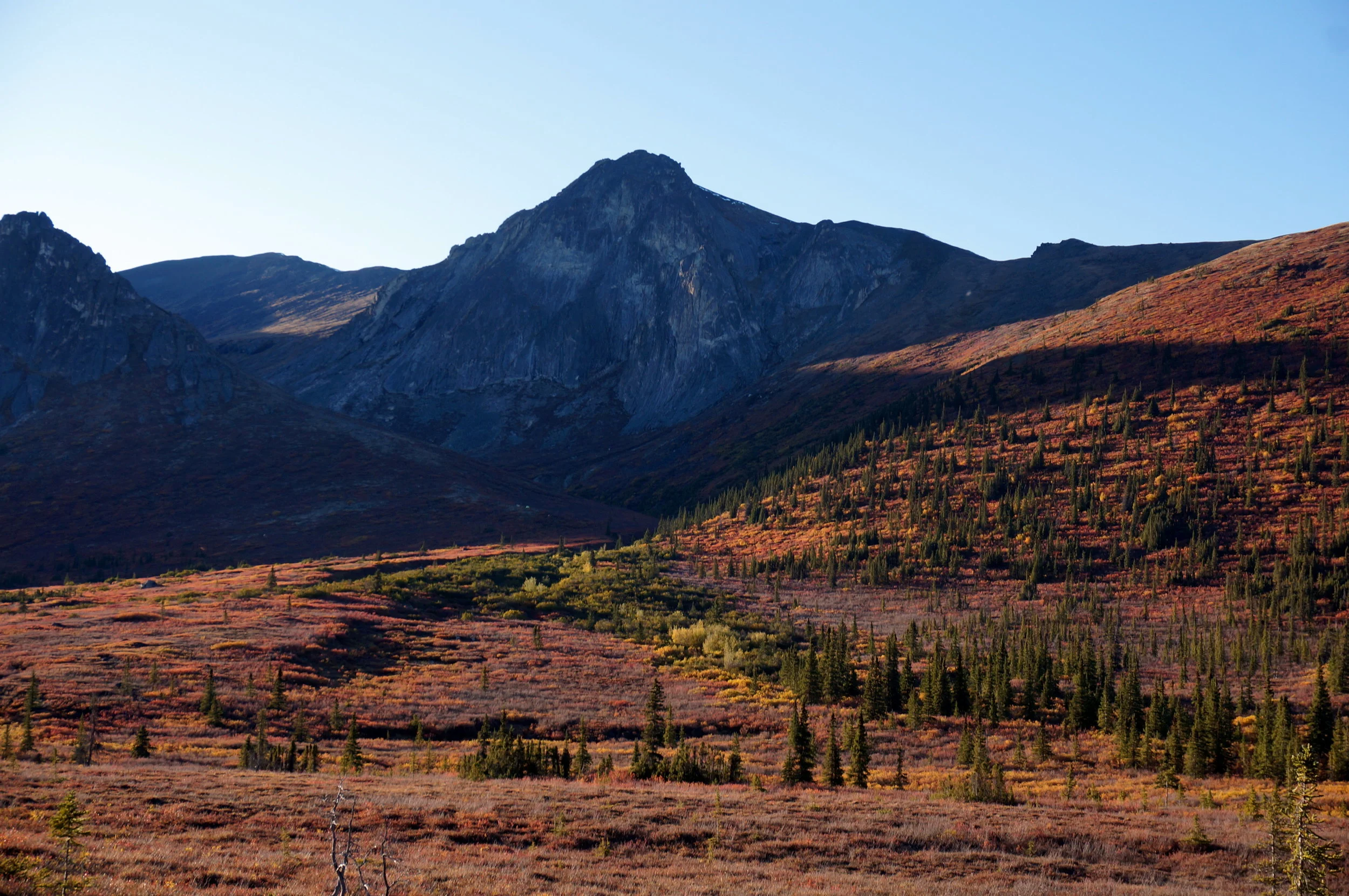
Photo by AAC Member Erica Lamb, Mt Prindle